Welcome to ConstructionGo, your all-in-one resource and guide for everything related to construction. Whether you are a homeowner planning your first build, a professional contractor, an architecture enthusiast, or someone exploring the field, ConstructionGo is designed to help you navigate the complexities of construction with clarity, insight, and practical knowledge. At ConstructionGo, we believe that successful construction projects are grounded in well-informed decisions.
Are you ready for the Football world cup and excited to be a part of it?
Today we will see how Engineers made it possible for the Football world cup in Qatar. In total they have – Eight stadiums with the highest capacity of 80,000. We will see one by one the details of the Qatar football stadium which will be the venue of the football world cup 2022.
1)LUSAIL Stadium: - The Highest capacity of 88,000 seats this stadium will be the venue for the final. This stadium construction was started in 2017 and it took 4 years, to complete this stadium, in 2021 it was ready to use, it was expected to be completed a bit earlier but due to the effect of Covid in 2019, it was late. Lusail Stadium was built by the China railway construction corporation and designed by Foster + Partners Architect. The stadium is inspired by the bowled and traditional Lantern, from the outside you feel a big bowl in front of you. Mr. Norman Foster has 5 main partners, Mr. Seif A, Mr. James, Mr. Gamma, Mr. Stefan, and Mr. Toby. There is the main project which the company has completed which includes building in every sector. And going projects are One Beverly hills, Euro American innovation city, New Slussen in Sweden, Parkin Place in Australia, and so on. many projects are appointed in 2008 and will be completed in 2025.
Lusail Stadium FIFA world cup 2022 Qatar by construction. Lusail stadium has 293 M in length and 78.6 M in height. The Cost to build Lusail stadium was 767 million dollars.
2)Education City Stadium –With an Average capacity of 45,350 seats, this stadium will be the venue for the league matches of 2022. This stadium construction was started in 2016 and it also took 4 years, to complete the stadium, in 2020 it was inaugurated, and As the effect of covid, it was also late. Education City Stadium was built by the Joannou and paraskevaides conspel and designed by Fenwick Iribarren Architect. The stadium facade is made of a beautiful triangle shape of glass whose color changes as per the movement of the sun, and at night it glows with amazing light works Fenwick Iribarren has made 22 stadiums with so many other big structures. It is also known for its 75,000-seating capacity stadium at New Valencia. Mr. Mark Fenwick and Mr. Javier Iribarren are the owners of the Fenwick Iribarren. Education City Stadium is 240 M in length and 80 M in height. The Cost to build the Education City Stadium was 610 million dollars approx.
3)Stadium 974 –With a seating capacity of 40,000 seats this stadium is listed in league matches of football 2022. This stadium construction was started in 2018 and it also took 3 years, to complete the stadium, in 2021 it was ready to use, it was built so fast that many were surprised by the speed of construction. Stadium 974 was built by the contractor, Joannou, and paraskevaides conspel and designed by Architect Fenwick Iribarren. Why 974? The stadium is situated in the coastal area and 974 was the code of Qatar international trade and 974 shipping containers is used to build its exterior. With just a great concept its color and innovation make it a great stadium.
Stadium 974 by Construction.in 974 Stadium has 235 M in length and 85 M in height. The Cost to build 974 Stadium was 500 million dollars approx.
4) Al Janoub Stadium–With a capacity of 40,000 seats, this stadium will be on the list of stadiums in league matches of football 2022, it will host a quarter-final match also. This stadium construction was started in 2014 and it also took 5 years, to complete the stadium, in 2019 it was ready to use, there were so many trusses and bridge work that the construction took a long time to complete. Al Janoub Stadium was built by contractor Six constructed and designed by AECOM and Zaha Hadid. Zaha Hadid had always had a unique concept, this stadium is also designed in a very style manner with the help of Trussell and bridges. She died in 2016 but her building will be remembered all the time Six Construct was established in 1965 with the main focus on the foundation, water treatment plants, and roads. They have a share in making Burj Khalifa. Al Janoub Stadium is 250 M in length and 79 M in height. The Cost to build Janoub Stadium was 700 million dollars approx.
5) Khalifa international stadium– With a capacity of 45,416 seats, this is also one in the list of the matches for the football cup 2022. This stadium construction was started in 1976 and become the main stadium for the Arabian gulf club, in 1976 also it was had full facilities and Morden design, however, it is renovated in 2005 and in 2017 also. Khalifa international stadium was built by the contractor, six construct and designed by Dar Al-Handasah Consultants.
Khalifa International Stadium World cup Qatar by Construction.in Khalifa international stadium is 250 M in length and 81 M in height. The Cost to build Khalifa international stadium was 100 million dollars approx.
6) Al Rayyan stadium has a 50,000 seating capacity which is the third largest in Qatar. Al Rayyan Stadium was started in 2001 and in 2003 it was completed. Design by Pattern design and built by Al Balagh & LT contractor.
Al Rayyan stadium Fifa world cup 2022 Qatar By Construction.Al Rayyan Stadium is 250 M in length and 77 M in height. The cost to build Al Rayyan Stadium was 600 Million dollars approx.
7) Al Bayt stadium has a 60,000 seating capacity, which is the second largest in Qatar. Al Bayt stadium was started in 2014 and completed in 2021. This Stadium will host the opening match of the FIFA world cup 2022 and the Final match of the Arab cup. This stadium is mainly built for the FIFA world cup 2022 Designed by Dar Al Handasah i This structure is designed like a big tent, which reflects the tradition of Arabs. With sliding roof make the stadium extremely beautiful
8) Al Thumama has a 40,00 seating capacity, Al Thumama Stadium was started in 2017 and completed in 2021. This stadium is also designed for the FIFA world cup 2022 Designed by Ibrahim M. Jaidah This structure is designed like a big Gahfiya, Gahfiya ( religious cap) is very important for Arabs. It looks so beautiful and so stunning.
Al Thumama stadium FIFA world cup 2022 Qatar by Construction. in Al, Thumama is 230 M in length and 80 m in height. Facts: - Most of the seats will be donated after the FIFA world cup 2022 to other countries for the development of the sport. Qatar will Host two cups back-to-back that is FIFA world cup 2022 and the Arab cup. Qatar will host the FIFA cup with 8 Stadiums.
Why Concrete needs curing: - Concrete needs to maintain the temperature at the time of heat of hydration. Without going much technically, when cement is mixed with water there is a chemical process and lots of heat is generated, and the hot gases are the reason for cracks, to maintain the temperature curing is done for its complete process. it lay a layer/film on the surface which does not allow its water to evaporate and additionally it makes the surface cool.
***
***
There are various methods of curing.
Sr. No
Method
Surface.
1
Curing with water pipes
Column and beams.
2
Curing with the ponding method
Slab and footings.
3
Curing with Gunny bags
Column, beams, and flooring.
4
Plastic sheet
Flooring and road.
5
Curing compound
All surface.
The first Four methods are the common method and we see them in regular practices, but today we see a new method which is curing compounds. It is a very highly effective method.
Curing compounds are also of different types.
Sr. No.
Methods
Remarks
1
Synthetic Resin compound
Very costly
2
Chlorinated rubber compound
Very costly
3
Acrylic compound
Cheap and effective
4
Wax compound
Very costly
Usage.
Sr. No
Applicable are Curing Compound
1
High ways
2
PQC Roads
3
Airport runways and Taxiway
4
Hard Standing and Aprons
5
Roof of concrete
6
R.c.c Retaining walls
7
Water Canals
Packaging.
It’s come in 200 kg and 250 kg Drum.
Advantages of Curing Compound.
Sr. No
Advantages
1
Reduce the plastic cracks in concrete which occur incedingly
2
To get the strength of the concrete of the desired level
3
Low Shrinkage due to continuous moisture
4
Due to the layer of compound, the cement dust does happen and it dust-free
5
Frost resistance increase
6
Water is saved in huge quantity
Usage of the Material.
It's high depending on weather conditions, if it's too hot you will need more curing compound, and if it's low then less, however, 5 to 6.5 m2 per liter is considered in normal cases.
Major Company in production of Curing compound.
Sika.
Fosroc.
Creeset.
W. R. Meadows – Seal tight.
Transhield.
Master Builder.
Euclid Chemical.
Baumerk – Construction chemicals.
Razon – innovative construction chemicals.
Armstrong Chemical private limited.
Process of use curing compound.
As per the selection of Curing compound (with water or without water ) it has to be filled in a spraying container and in mist form, it has to be sprayed.
are undertaken and 28 days of results are awaited. Based on early-age strength, the following mixes are suggested for site trials. Detailed report follows
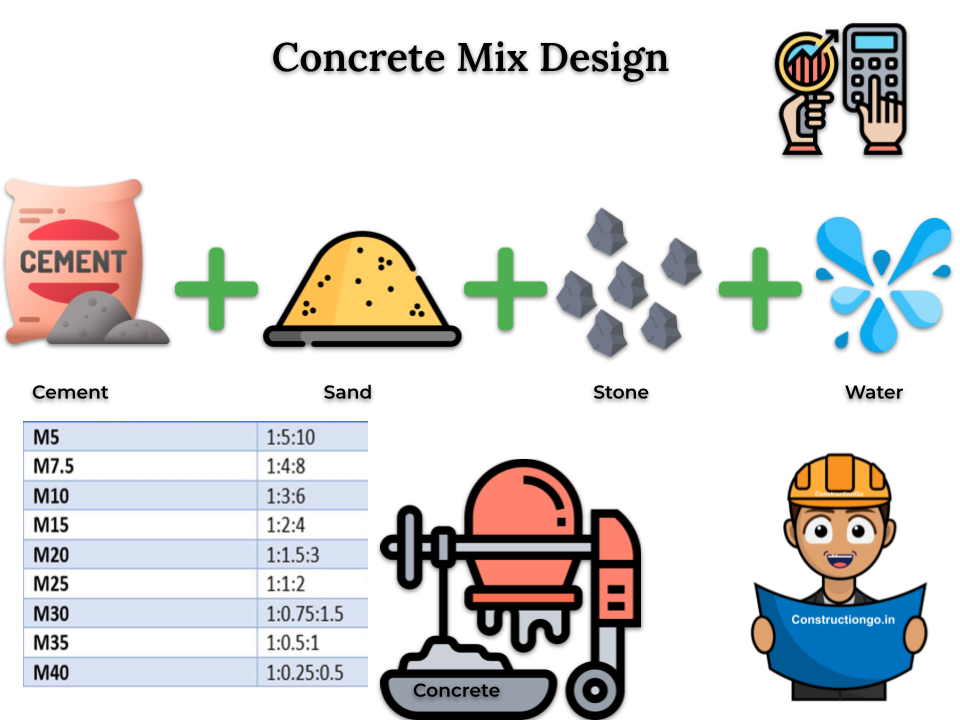
Concrete mix design is the process of determining the proportions of cement, water, fine aggregate, and coarse aggregate for a specific strength and durability requirement.
M20 grade of concrete refers to a mix design with a characteristic compressive strength of 20 MPa (Mega Pascals) at 28 days.
The mix design for M20 grade concrete can be done using various methods such as the IS Method, the ACI Method, or the USBR Method.
However, the most commonly used method in India is IS Method.
The IS Method for mix design of M20 grade concrete includes the following steps:
Selection of water-cement ratio: A water-cement ratio of 0.55 is selected for M20 grade concrete as per IS 456:2000.
Selection of nominal mix proportions:
Nominal mix proportions of 1:1.5:3 (cement: fine aggregate: coarse aggregate) are selected for M20 grade of concrete as per IS 456:2000.
Selection of water content: The water content is determined based on the workability requirement, which is usually between 160-180 kg/m3.
Selection of fine aggregate: The fine aggregate should be clean and free from organic impurities and should conform to IS 383-1970.
Selection of coarse aggregate: The coarse aggregate should be clean and free from organic impurities and should conform to IS 383-1970.
Mix design calculation: Once the above parameters are selected, the mix design calculation can be done to determine the proportions of cement, water, fine aggregate, and coarse aggregate.
It's worth mentioning that the above steps are general guidelines and the mix design may vary depending on the specific project requirements, materials availability, and other factors.
It's also important to note that the mix design is a laboratory process and the quality of the concrete in the field will depend on many factors such as proper mixing, curing, and protection from environmental conditions.
2) Mix Design of M25
Properties For M25
Mix Proportion (By Weight) :- 1 : 1.99 : 3.25
Water Cement Ratio:- 0.42
Cement Content :- 375 kg / cu.m
Natural Sand Content:- 746 kg / cu.m
Coarse Aggregates 20 mm :- 914 Kg / cu.m
Coarse Aggregates 10 mm :- 305 Kg / cu.m
Admixture SP-430 G8 of Fosroc Chemicals 250 ml/bag Water Content (W.rt.WCRatio) 157.5 Lit / cu.m
Water Absorption of CA :- 1.0% 12.1 Lit / cu.m
Water Absorption of FA :- 1.2% 8.9 Lit / cu.m
Total Water Content :- 178.5 Lit / cu.m
7 days strength :- 22.6 Mpa
***
***
Note: The cement content recommended is based on early age strength. After confirmation of 28 days' strength, cement content may reduce.
∙ The above water content is recommended considering dry aggregates; as such correction for absorption is made. In order to maintain workability, proportionate adjustment as above (water absorption), in the quantity of water shall be made, if the aggregates are wet.
∙ The grading of the aggregates shall be checked regularly & should match the grading of aggregate received in the laboratory as this may have an effect on the strength & other characteristics of the concrete. If necessary adjustments/corrections in the proportion of fine aggregate shall be made.
∙ Admixture used, shall be SP-430 G8 of Fosroc Chemicals. The quality of the admixture shall be checked regularly. If required dosage shall be adjusted according to site condition and workability requirement, keeping the same water-cement ratio as recommended above.
∙ The above results are related only to the sample tested in this laboratory.
∙ No report shall be reproduced, except in full, without the written approval of this laboratory. ∙ Any query about the report may be reported immediately.
Mix Design M40
2.2 Sieve Analysis
Sieve Size
Percent Passing
mm.
31.5mm.
10 mm.
Natural Sand
31.5
100
100
100
26.5
97.3
100
100
19
67.2
100
100
9.5
15
78.8
93.3
4.75
2.8
0.5
75.4
0.6
0
0
26.9
0.15
0
0
0.9
0.075
0
0
0.4
Properties of Aggregate
Sr.
Properties
Natural Sand
Coarse Aggregates
a.
Specific Gravity
2.64
2.85
b.
Water absorption
1.2 %
0.9 %
c.
Deleterious Content
Nil
Nil
Tests on Cement and Flyash
a.
Consistency
29.0 %
b.
Specific Gravity
3.10
c.
Initial Setting time
145 min
d.
Final Setting time
210 min
e.
Soundness by Le’Chattelier Expansion
0.5 mm
f.
Specific Surface by Blain’s Air
284 sq.m / Kg
g.
3 Days Compressive Strength
37.5 Mpa
h.
7 Days Compressive Strength
51.5 Mpa
i.
28 Days Compressive Strength
58.0 Mpa
j.
Specific Gravity of Flyash
2.22
k.
Specific Surface by Blain’s Air of Flyash
348 sq.m / Kg
MIX STIPULATION
The following design, stipulations are considered based on the site conditions and requirements of IRC-15 & MORT&H2013
Properties
M40 PQC
Type of concrete
Pavement Concrete
Degree of exposure
Moderate
Degree of quality control
Good
Degree of Workability
25 – 30 mm. slump.
Maximum size of aggregate
31.5 mm
Maximum Water Cement Ratio
0.45
Minimum cementitious content
310 kg./cu.m.
Retention time
60 min
Target Mean Strength (ft)
As per IRC : 58/MORTH specifies Fcr = 4.5 Mpa (For M40 PQC) fcr = Characteristic Compressive strength in ,N/mm.sq
As per IRC: 44 Target average flexural strength is given as f ʹcr = fcr + 1.65 x Sf
f ʹcr = Target average flexural strength at 28 days, N/mm.sq.
fcr = Characteristic flexural strength (design strength) at 28 days,N/mm.sq.
Sf = Standard deviation of flexural strength, N/mm.sq. (Table 5 of IRC : 44 - 2017) Hence f ʹcr = 4.42 + 1.65 x 0.40 = 5.08 Mpa
Compressive strength: As per MORTH target mean compressive strength for M40 grade is 52.0 Mpa
RECOMMENDATIONS
The mix is designed as per the guidelines of IS:10262. Based on the results of a number of trials, the following mix is recommended for concrete. Details of trials taken are enclosed in the Appendix.
Properties
For M40 PQC
Ratio / proportion – weight
1 : 1.99: 2.43
Water Cement Ratio
0.32
Cementitious Content
425 kg / cu.m
Cement Content
319 kg / cu.m
Flash Content
106 kg / cu.m
Natural Sand Content
845 kg / cu.m
Coarse Aggregates 31.5 mm
723 Kg / cu.m
Coarse Aggregates 10 mm
310 Kg / cu.m
Admixture - 300 Fosroc Chemicals (Auramix)
4.2 Kg / cu.m
Water required in liter
136.0 Lit / cu.m
Water Absorption of CA @ 0.9 %
9.2 Lit / cu.m
Water Absorption of FA @ 1.2 %
10.1 Lit / cu.m
Total Water Content
155.3 Lit / cu.m
The above water content is recommended considering dry aggregates; as such correction for absorption is made. In order to maintain workability, proportionate adjustment as above (water absorption), in the quantity of water shall be made, if the aggregates received are wet.
The admixture used shall be, Auramix 300 of Fosroc Chemicals. The quality of the admixture shall be checked regularly.
The density calculated for the above-recommended mix is based on a laboratory trial. If there is any variation in material gradation, proportions of ingredients shall be adjusted by measuring the actual density at the site, while maintaining the same cement content.
The quality of fly ash shall be confirmed before use. The Blain’s air-specific surface shall not be less than 320 sq.m/kg.
APPENDIX – I
1.0 MIX TRIALS
Based on the test results of different ingredients and considering the design stipulations, the initial mix is designed as per the guidelines of IS:10262 as indicated below
MIX AS PER IS 10262: 2019 (Trial 1)
VERIFICATION OF MIX AS PER IS:10262
The weights determined above (i.e. as per IS:10262) are converted into proportions and a trial was taken. The observations are as under –
Properties
Trial 1
Observations
Mix
Proportion
1 : 1.63: 2.89
Mix prepared indicated
higher workability.
The sand content in the mix is 36%,
and segregation was observed.
The actual density is lower
then the theoretical one,
resulting in a higher yield of concrete.
This must be matched to avoid variation
goog_144801757 in the quantity of concrete delivered at the site.
Water Cement
Ratio
0.35
Cementitious
content
425 Kg/cu.m
Cement content
319 Kg/cu.m
Flash content
106 Kg/cu.m
Admixture
Dosage
@1.0%
Slump
Observed after
60 min
120 mm
Actual Density
2466 kg/cu.m.
Correction in
Mix required
Yes
Mix prepared as per IS indicated deficiencies. Workability achieved is higher, desired workability can be achieved by reducing the water-cement ratio from 0.35 to 0.32. Sand cement increased from 36% to 45%. Fines in the mix are meager, This not only leads to segregating mix but also the combined grading does not fit-in grading as per IRC- 15:2017, MORT&H2013. Also, there is a significant difference between theoretical and actual density. This need to be matched to avoid a difference in yield. Considering all points, the mix is revised.
With actual density as a base, and cementitious content is as per IS trial i.e 425 kg/cu.m. mix proportion is revised. Fines are increased not only to achieve cohesiveness but also to meet IRC-15: 2017, MORTH2013 grading requirements. The proportion of aggregates are finalized as –
Natural Sand :
45.0 %
31.5 mm. :
38.5 %
10 mm. :
16.5 %
Trial 2
With the re-proportioned aggregates and cementitious content being 425 kg/cu.m., this trial was conducted with WCR 0.32 and an admixture dosage of 1.0%. The details of the mix are given below
Properties
Trial 2
Remarks
Mix Proportion
1 : 1.99: 2.43
This trial was carried out with
cementitious content of 425 Kg/cu.m.
With 45% sand content, the mix indicated good cohesiveness and texture
The strengths achieved are
satisfactory for M40
Water Cement Ratio
0.32
Cementitious Content
425 Kg/cu.m
Cement Content
319 Kg/cu.m
Flyash Content
106 Kg/cu.m
Admixture
@1.0%
Initial Slump observed
165 mm
Slump observed after 60 min
60 mm
7 Days of compressive strength
36.3 Mpa
7 Days Flexural strength
3.34 Mpa
28 Days compressive strength
52.8 Mpa
28 Days Flexural strength
5.25 Mpa
Trial 3
In the previous mix, the strength achieved is satisfactory for M40. One more trial was carried out with cementitious content of 450 kg./cu.m. The results are presented below –
Properties
Trial 3
Remarks
Mix Proportion
1 : 1.85 : 2.26
This trial was carried out with cementitious content of 450 Kg/cu.m. With 45% sand content, mix indicated good cohesiveness and texture The strengths achieved is higher for M40
Water Cement Ratio
0.30
Cementitious Content
450 Kg/cu.m
Cement Content
338 kg./cu.m
Flyash Content
112 kg./cu.m
Admixture
@1.0%
Initial slump
160 mm
Slump observed
after 60 min
55 mm
7 Days of
compressive strength
40.8 Mpa
7 Days Flexural strength
3.86 Mpa
28 Days
compressive strength
55.3 Mpa
28 Days Flexural strength
5.62 Mpa
Based on the above trials mix with cementitious content of 425 kg./cu.m. is finalized for M40 PQC.


.png "Best for curing")